
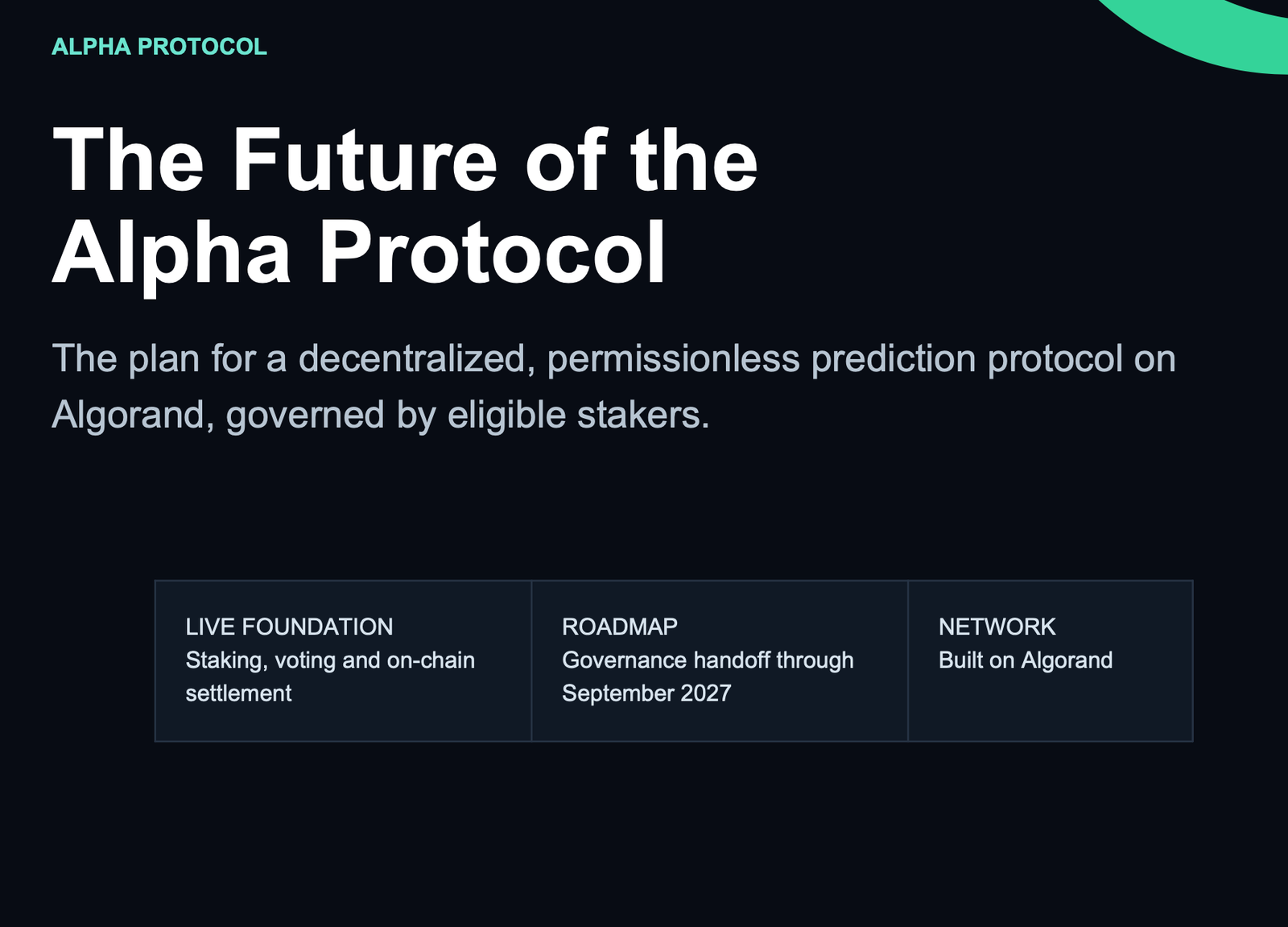
Alpha Arcade, the prediction market platform built on Algorand, has published a new whitepaper laying out its transformation from a team-operated platform into a fully decentralized, permissionless prediction protocol governed by token stakers.
The document, dubbed the Alpha Protocol whitepaper, describes a roughly twelve-month rollout that would progressively hand control of market creation, fee distribution, treasury management, and protocol upgrades to $ALPHA stakers, culminating in a complete governance handoff targeted for September 2027. The end goal, according to the team, is for all protocol code to be open sourced, with audit reports published along the way.
The foundation is already live on mainnet: $ALPHA staking, resolution voting, optimistic resolution, and order-book trading with on-chain settlement. From there, the roadmap moves in stages — additional staking assets in October 2026, community-led market creation in December 2026, expanded fee distribution in January 2027, LP and trader rewards in March 2027, and treasury and vesting governance by June 2027.
One of the more interesting mechanics is community market creation. All markets will need to match staker-approved templates — the whitepaper lists examples ranging from binary events and multi-outcome sports markets to on-chain governance questions like “Will Algorand Proposal #123 pass?” and protocol metrics such as whether Algorand’s online stake exceeds 2 billion ALGO. Market proposers and approving voters will earn a share of the trading fees their markets generate, creating a direct incentive to source quality markets.
Disputed resolutions, which today go to the Alpha team as arbitrator, will instead go to stakers of $ALPHA and approved liquid staking tokens. Fee distribution itself becomes a governance decision, with stakers voting on how protocol fees are split between market creators, resolvers, stakers, LP rewards, buyback-and-burn, and trader incentives.
The whitepaper also discloses the full $ALPHA allocation for the first time in this framework: a minimum of 30.42% is committed to the community treasury under staker governance, 24.08% covers initial protocol funding and existing circulation, 17.37% is reserved for team and contributors (with stakers approving individual grants and vesting terms), 20% sits in a flexibility reserve for licensing and future development, 7.5% is earmarked for a US regulatory application — 75 million tokens offered at $0.006, targeting $450,000 in legal and filing costs — and 0.63% has already been burned.
Alpha Perpetuals targets Q4 2026
Beyond prediction markets, the whitepaper details Alpha Perpetuals, a perpetual futures product currently in beta for $ALPHA holders with a production launch targeted for Q4 2026. The design pairs off-chain order matching with Algorand-based custody and settlement, using USDC collateral vaults and an independent signer group to validate fund movements. Initial support includes up to 20x leverage, cross- and isolated-margin, and ALGO/USD and BTC/USD pairs, with net fee revenue flowing back to $ALPHA stakers under the same governance framework.
The team is also exploring novel perpetual markets tied to real-world data — the whitepaper floats the example of going long Justin Bieber and short Lady Gaga using Spotify streams as the oracle. These would use the same template governance system and remain contingent on regulatory review and oracle availability.
Also on the table: a possible shift from the current central limit order book to a request-for-quote model, a decision the team says will be put to a staker vote before implementation.
On the regulatory front, US access to Alpha Perpetuals may remain restricted during the licensing process, and any US participation in $ALPHA token offerings is limited to accredited investors. The team is targeting US regulatory approvals and an iOS app launch in 2027.
All roadmap dates are described as estimates subject to technical, regulatory, and governance factors. The full whitepaper is available at alphaarcade.com/whitepaper.
Download the white paper here. [PDF] [Web]